Lighthearted Arena Showdown
Reviews
Lighthearted Arena Showdown is a local two-player game that strips away health bars and complex scoring in favor of direct hits and a time limit. Its strength is accessibility: split keyboard controls, clear arena boundaries, and distinct character abilities make it easy to start and tactically interesting to repeat. The lack of online or additional player support limits its scope, but for parties, breaks, or quick matches between friends, the short round structure and lighthearted presentation fit the purpose.
Description
Two-Player Arena Design
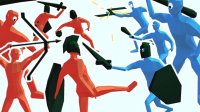
Lighthearted Arena Showdown is built around a single local match between two players on one keyboard. Each participant selects a character that differs in movement style and special ability, so the matchup changes depending on who faces whom. The arena is bright and uncluttered, with clearly marked boundaries that help both players track their position without visual noise. There are no health bars or layered scoring systems. A round ends when one player lands a set number of successful hits or when a time limit expires, which keeps each session short and readable.
Controls and Character Abilities
Player one moves with WASD and triggers a special move with F. Player two uses the arrow keys for movement and K for their special ability. This split layout lets both people play on the same keyboard without overlapping inputs. The controls are responsive, so quick reactions and smooth movement across the arena are possible. Special moves are the main tactical tool: they can surprise an opponent, cut off an escape route, or force a reaction at a key moment. Because each character's movement and ability differ, learning the opponent's options matters as much as landing your own hits.
Round Flow and Positioning
Each round starts with both characters at opposite ends of the arena. Players navigate the space, avoid incoming attacks, and look for openings to land their own strikes. Positioning is central: staying near the boundary limits escape options, while drifting toward the center can leave a player exposed. Special moves add a layer of prediction, since a well-timed use can corner the other player or reverse momentum. The match concludes once a competitor reaches the predetermined number of successful strikes or after the set time limit runs out.
Visual Clarity and Accessibility
The graphics are colorful and uncluttered, and characters are distinct and animated in a lighthearted manner. That visual clarity reduces confusion and lets players focus on the competition rather than parsing the screen. The rules are minimal and the controls are straightforward, so newcomers can learn the basics within seconds. No prior experience with similar titles is required. The game is designed for short play sessions, making it suitable for parties, breaks, or quick matches between friends. The absence of mature themes means it is appropriate for children and adults alike.


Editorial Notes